My AI Operating System
I've built a system — configured agents, codified workflows, and shared infrastructure that gets smarter over time. Here's how it's structured.
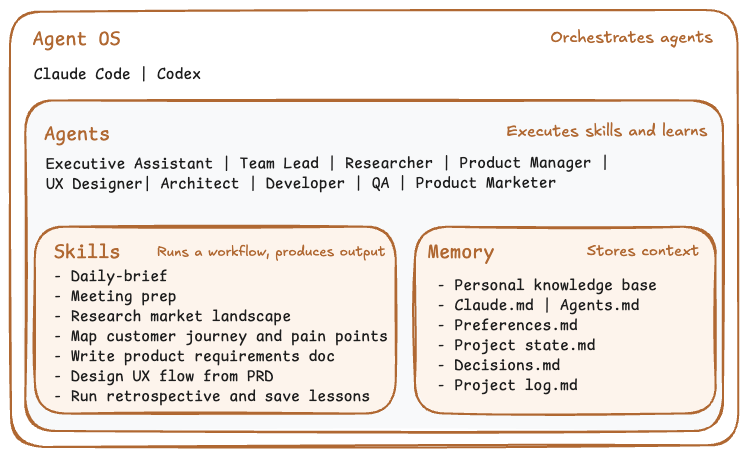
Configured for a job. Not just prompted.
An agent isn't just an AI you talk to — it's an AI configured with the right context, tools, and operating rules to do a specific job. Every agent I run carries a global preferences file that improves it over time, plus per-project context that scopes its behavior.
Claude
CLAUDE.mdPRIMARY AGENT FOR PRODUCT AND ENGINEERING WORK
Runs with global context (CLAUDE.md + PREFERENCES.md) loaded at every session. Per-project CLAUDE.md files scope behavior and operating rules for each repo. Sub-agents spawn inside Claude sessions when specialized roles are needed.
Codex
AGENTS.mdPRIMARY AGENT FOR PRODUCT AND ENGINEERING WORK
Runs with global context (AGENTS.md + PREFERENCES.md). Per-project AGENTS.md files define operating rules. Same sub-agent pattern as Claude — role-specific agents layer on top of the primary session.
Architect
Designs system architecture with constraint-first evaluation
Evaluates architecture proposals against constraints before elegance. Produces explicit non-decisions alongside recommendations. Deployed when a project needs rigorous technical architecture review.
PM
Drives product requirements and decision framing
Works from locked decisions and open questions. Frames every recommendation as options with explicit tradeoffs. Deployed when a project needs structured product thinking.
UX Researcher
User research, interaction patterns, and design handoff
Scoped to research and interaction design — does not make engineering decisions. Produces findings with direct implications for product decisions.
Team Lead
Session orchestration, narrative capture, phase discipline
Manages session start/close protocols, prevents silent phase transitions, captures decisions and surprises in narrative logs. The connective tissue across a multi-agent project.
Researcher
External research with sourcing standards and structured output
Sourcing standards enforced — findings attributed, not hallucinated. Output format designed to feed directly into PM and Architect decision-making.
Executive Assistant
Scheduling, communication, and administrative coordination
Handles calendar management, drafts communications, and organizes administrative tasks. Keeps the operating layer running so focus stays on high-leverage work.
QA
Quality assurance and test coverage
Reviews builds for edge cases, writes test scenarios, and validates that shipped features meet defined acceptance criteria.
Product Marketer
Positioning, messaging, and go-to-market
Translates product capabilities into sharp positioning and audience-specific messaging. Deployed when a build needs a clear narrative before launch.
Developer
Focused code implementation and technical execution
Scoped to implementation — takes a defined spec and ships it. Works alongside the Architect for complex builds and the QA agent for validation.
What agents work with.
Three categories of tools that agents draw from: context files that tell agents who I am and how I work, MCPs that connect agents to external systems, and skills that codify repeatable processes so I never explain the same workflow twice.
Context Files
PREFERENCES.md
GlobalObserved working patterns accumulated across all projects. Every agent reads this first. Gets updated when a new behavior pattern is confirmed across multiple sessions.
CLAUDE.md / AGENTS.md
Global + Per-projectGlobal file sets universal operating discipline. Per-project file scopes behavior, defines team structure, and sets context for the specific work in that repo.
Obsidian Vault (Personal knowledge base)
PersonalSecond brain and daily planning system. Source of truth for goals, notes, and personal context. Agents pull from it when personal or professional context is needed.
MCPs
mMCP
Personal MCP server — single entry point from any agent (Claude or Codex) to downstream tools. Currently connected to Linear. Eliminates per-project connector setup and gates what agents can access.
Skills
Brief
/briefDelivers a structured session start: current project status, what's working, last session summary, next recommended action, and open decisions needed.
Claude CodeRetro
/retroEnd-of-session retrospective — captures what was built, decisions made, surprises, and appends to the project narrative log.
Claude CodeStandup
/standupCross-project status roll-up across all active repos.
Claude CodeProcess Daily
/process-dailyProcesses yesterday's Obsidian daily note — extracts tasks, routes to project files, classifies as action vs. motion, generates today's starting context.
Obsidian + ClaudeExcalidraw
/excalidrawGenerates system diagrams from text descriptions directly inside Obsidian.
ObsidianI build with the same tools I'd recommend to any product team moving fast on AI. Everything here is production-tested in my own workflows first.
Want to see this system applied to a real project?